Friday, February 28, 2014

創新麺庵 生粋 Kissui: the taste of mackerel

The Japanese title of filmmaker Yasujiro Ozu's understated final masterpiece, An Autumn Afternoon, is sanma no aji, which is "the taste of mackerel pike." Sanma is a long, knife-shaped fish that is most prominently found in stores in the fall. Cooked shioyaki, or salted and grilled, it's a fish that is served with its silver skin on, head and guts intact, luminous, rich, and smoky. Those guts are highly nutritious, but also gritty and bitter. It is, in short, a fish that appropriately captures the feelings of Ozu's swan song, a melancholy etude to aging, loneliness, and obligation.


I walked into Kissui on a cold and rainy day, just before the lunch rush. I was the only customer inside, and the ramen wasn't completely ready yet. 


Instead of using the typical bonito or skipjack tuna dashi of typical shops, Kissui specializes in a shoyu ramen that is derived nearly entirely from sanma. While the fish is most plentiful in the autumn season, it can be found all year round. And thank goodness.

Shoyu soba (700yen)

This is a bowl that is as rich and savory as any I've ever had. The smoky essence of the sanma comes through in the first bite, but the quality of the fish never becomes cloying. 


The key to Kissui's bowl is its balance, as the soup has so much umami that the toppings need to be slightly restrained, yet never mediocre. The soup clings to the springy noodles; the smoked, thick-cut chashu has a great dry texture; and the onions and mizuna greens provide a great freshness. This is a bowl greater than its parts, whose every player has been orchestrated to evoke an emotion, and whose subtle simplicity displays a martinet control.
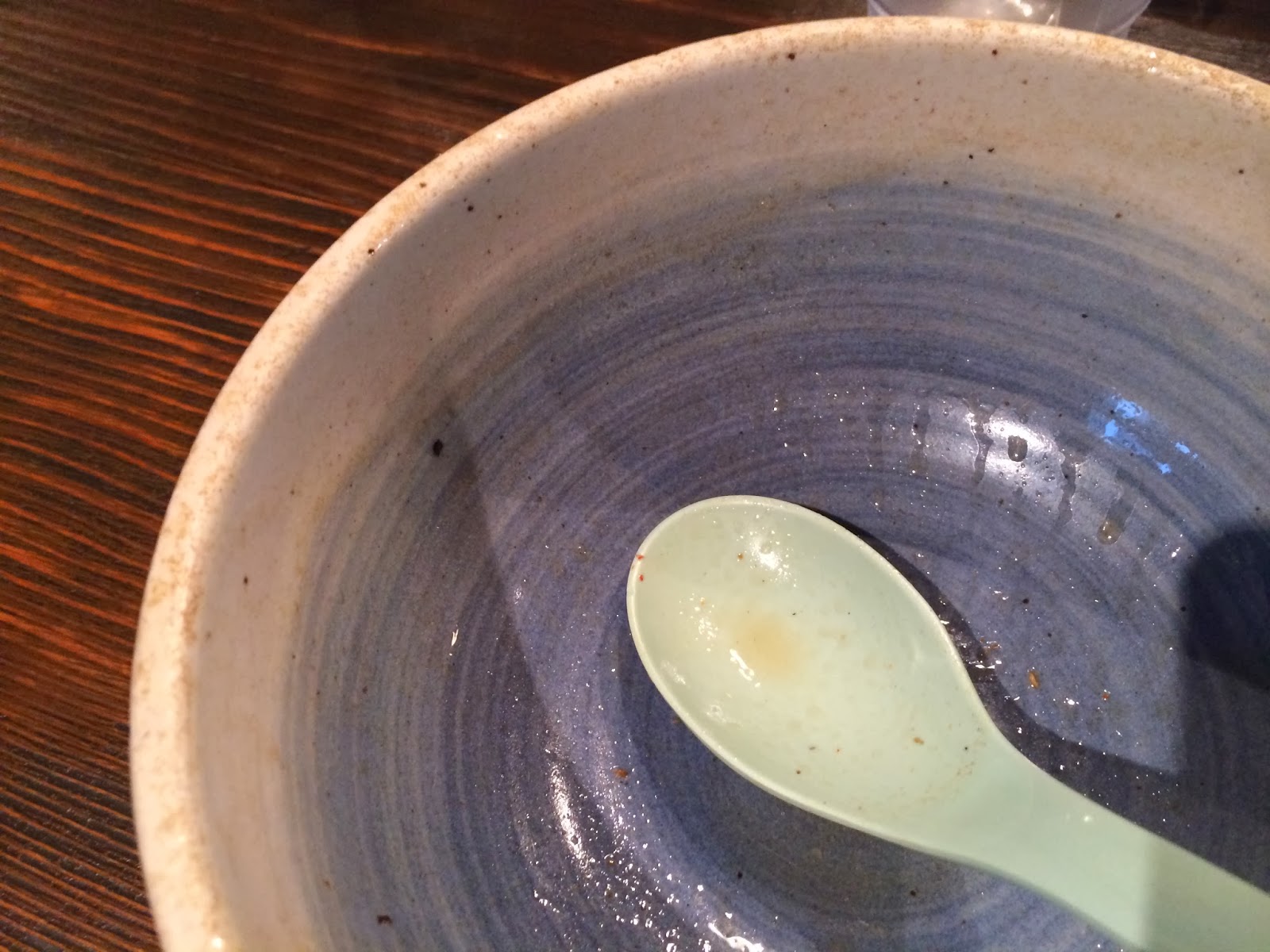

Sometimes words can't completely express the feeling of contentment. This was a masterful bowl.


Tokyo, Toshima-ku, Ikebukuro 2-12-1
Closest stn: Ikebukuro

Open from 1130am-3pm and 6-1030pm (closed Tuesdays, slightly earlier on weekends)

Hearts

Thursday, February 27, 2014

みん亭 Mintei: dirty dancing

Can you imagine what the ramen would taste like in a shop that looks this old and dirty?


Mintei even received a reward for "dirty but delicious" restaurant. Sounds interesting.


Mintei is an old and cheap restaurant serving Chinese food. It's beloved by the locals of Shimokitazawa, having been in business for nearly 50 years. Most of the customers that came in were salarymen drinking and eating with their subordinates.


The wall was covered with autographs, but I couldn't recognize any since they were so old. But I did hear that Hiroto Komoto, the lead vocal of the legendary punk rock group The Blue Hearts, used to work here part-time.

"Ramen will save mankind"

We ordered gyoza…


…mapo ramen…

Mapo ramen (750yen)

…and the signature Edokko Ramen. Edo is the old name for Tokyo, and Edokko essentially means the "people of Tokyo."

Edokko ramen (650yen)

The noodles in both bowls are thin and smooth, and the Edokko Ramen is a sweet and simple shoyu. I'm not sure what is specifically "Edo" about this bowl, but it is topped with kimchi. This isn't extraordinary ramen by any means, but the atmosphere - despite its shabbiness - is strangely relaxing.


Mintei's cheap prices and substantial portions have grabbed the hearts of the locals of decades. This isn't a date spot, but the lesson is "don't judge a ramen shop by its crumbling exterior." Or something.


Tokyo, Setagaya-ku, Kitazawa 2-8-8
Closest stn: Shimokitazawa

Open from 1130am-1130pm (closed Mondays)

Lum

Friday, February 21, 2014

中華料理 大宝 Taiho: tanmen at work

Lest you think Nakamoto is representative of the typical tanmen, I am here to educate you. Pull up your chair, get out your notepad, and gather 'round.

Or better yet, head to Taiho, in the obscenely decadent neighborhood of Shirokane. Beware, for their hours are extremely limited - only two hours for supper. Occasionally they'll open for lunch, but it's a gamble - thou hast been forewarned.


Tanmen is an offshoot of ramen. The soup is typically a light shio base, and the broth can be composed of chicken stock, lots of simmered vegetables, and spices. The signature of every tanmen is a heaping pile of steamed or stir-fried vegetables, so that the bowl is equal parts vegetable soup as ramen. Tanmen can be a soul-soother on these cold and dark winter nights, as its hot and filling but not as oily as your average ramen.

Make no mistake, Taiho is one of the best, displaying all the hallmarks of an idiosyncratic institution. Limited, unpredictable hours? Check. Old-school atmosphere frequented by regulars? Check. Mom and pop running the place by themselves for decades?


Check. The intangibles are accounted for. Start off with some gyoza…


…some delicious fried rice…


…and one of the best tanmen you'll have in Tokyo.

Tanmen (800yen)

A dish that could feed a kingdom. Taiho's tanmen is loaded with pepper, so the soup packs a ton of punch. The veggies are usually bean sprouts, cabbage, and nira garlic chives, with lots of chopped pork throw in to flavor.


The noodles are springy and chewy, maybe the tastiest tanmen noodles I've ever had.


Lots of years spent perfecting this one, and it shows.


Tokyo, Minato-ku, Minami-Azabu-shi 2-7-23
Closest stn: Shirokane-Takanawa

Open from 12-2pm and 8-10pm (sometimes they'll open slightly earlier or later, depending on the day)

Hearts

Tuesday, February 18, 2014

蒙古タンメン中本 Nakamoto: this bowl goes up to eleven

I haven't been able to eat ramen with Hearts these days, and this makes me sad. But! As long as there is ramen, I will not relent.

Nakamoto is a chain of shops famous for their spicy ramen which includes tons of red peppers and thick noodles. I went to the one in Kichijoji, but they have shops all over Tokyo.


Apparently, Nakamoto started as a Chinese restaurant which served spicy foods in Itabashi, but they closed shop once because of the master's health problems. However, one enthusiastic regular named Mr. Nakane was eager to carry on their taste, and he opened up his own shop in 2000 after rigorous training. Now, Nakamoto has lots of branches and many enthusiastic customers.

I ordered the Ladies' Set, which comes with a half-sized ramen...

Moko-tanmen 1/2 size set (580yen)

 ...and a half bowl of mapotofu. The price for this much food is great.


The signature here is the Moko-tanmen, which contains lots of vegetables and spicy tofu infused with a thick, starch-based sauce similar to mapotofu. Nakamoto is famous for having different levels of spiciness to choose from - 0 being not spicy at all, and 11 being that extra push over the cliff. Be very, very careful when ordering 11.


I'm a big fan of Nakamoto, and I really enjoy the spiciness and chewy noodles that give the bowl a little kick of sweetness. This is "energy ramen," which sort of explains why they are so many fans of these shops. Despite the abundance of ramen shops in Tokyo, there aren't that many famous mini-chains like Nakamoto, so they are doing something right.


Almost every item on the menu is spicy and is a little tricky to manage for spice-sensitive eaters. But be careful, since the contents are really hot! Don't sip from this bowl; just put the noodles into your mouth silently, or you won't be able to stop coughing from the heat and spice!

Tokyo, Musashino City, Minami-cho, 2-9-10
Closest stn: Musashi-sakai

Open from 11am-Midnight

Lum

Thursday, February 13, 2014

北海道ラーメンおやじ Oyaji: machida miso

There are places that are colder, but Tokyo is still cold. Especially in February, where the most snow in 45 years was about to fall and blanket the city for days.


Few ramen options are better to beat the cold than a warm and creamy bowl of miso. Oyaji, way out in the Tokyo suburban enclave of Machida, is a trek, but worth it for perhaps the best miso in the Kanto area. 


Oyaji stir fries bean sprouts, cabbage, and onions in a wok along with their miso before making the ramen. You can watch the fiery action in the back.


Oyaji means "old man" in Japanese, and can be used in a variety of situations from a casual way to refer to dear old dad, to a description of the local ramen master. The Oyaji Set comes with a side of gyoza, but be careful, for it is a ton of food. 


The Oyaji Ramen, topped with stir fried vegetables and filled with egg noodles - typical of miso bowls and ideal for soaking up the stew. 

Oyaji-men (750yen)

Miso must have impact for its first bite, and Oyaji delivers with a sharp taste that spreads all over the mouth. But where most miso ramen lose their way after a few slurps, Oyaji's bowl tastes good until nearly the very end, with hints of corn and butter mingling with the miso and vegetables all the way through. 


I say nearly because even by the end it started to feel like a chore to finish this bowl of creamy potage noodle soup. Oyaji is an elite miso option, but only a trip to the miso ramen birthplace of Hokkaido will likely satisfy the true misoul.


Tokyo, Machida City, Nakamichi 1-19-1
Closest stn: Machida

Open from 1130-1230am

Hearts