Monday, January 19, 2015

麺や 庄の Shono: ramen creator

From one mad scientist to another...


Shono-san's shops are legendary and legion. We've already been to his tsukemen shop, 2-Chome GACHI and his abura soba shop, also GACHI Abura Soba. For the first new shop of the year, we introduce Shono-san's original shop in Ichigaya. Shono dubs himself a "ramen creator," and his bowls are always coming and going at the whims of their creator's restless mind.


Shono's original ramen is a tonkotsu-gyokai blend, soaked in pork bones over two days, that is a very porky rendition of the ubiquitous bowl.

Ramen (760yen)


It's a solid bowl, but Shono is known for his wild, limited-edition creations. Here's a sampling of some of the stuff that Shono has offered in the past.

First up, one of his menu's staples, the kamatama tsukemen.

Kamatama tsukemen (900yen)

A fusion of abura soba and tsukemen, this is an extremely filling bowl that's now offered only in the summer. You mix the noodles with all the toppings - chashu, niboshi, green onions, raw egg, fried noodles - and have a few bites before dipping it in the broth.

Next up, the salmon tsukemen.

Salmon tsukemen (980yen)

A rich blend of salmon paste and tonkotsu pork broth, this is heartier than it looks, but the combination is terrific, giving the usual tonkotsu-gyokai mix a sharper, smokier flavor.

Last winter, Shono had a fantastic oyster tsukemen, with a sour oyster and pork broth filled with lemon slices, paired with noodles soaked in hot dashi water.

Oyster tsukemen (1000yen)

Basil oyster, menma pickled in ume sour plum, and two different spicy pastes rounded out this complex bowl.


This year, Shono has brought back his super-hyped foie gras bowl: a broth that blends rich fois gras paste with a tori paitan chicken stock, and topped with several generous slices of foie gras, extra foie gras oil, and some ume grated daikon for a refreshing kick. As usual, it has an exquisite attention to design and color.

Foie gras tori paitan (1000yen - full disclosure, this bowl was eaten at sister shop GACHI)

The noodles are thick and al dente, chewier than his usual ramen or tsukemen, almost like an Italian pasta in texture.


This is one of the richest bowls I've ever had. By the end of the bowl, I felt like I had downed 2000 calories. Due to extensive popularity, Shono-san is putting this bowl out until the end of January. You can only get it at his gotsubo branch, but get there early as it's limited to just 20 bowls a day.


Shono-san's bowls are delicious, but also works of art in and of themselves. In a world of ramen derivation, Shono-san is truly a singular genius.

Tokyo, Shinjuku-ku, Ichigayatamachi 1-3
Closest stn: Ichigaya

Open from 11am-3pm and 5-11pm (11am-5pm on Sundays)

Hearts

Friday, January 9, 2015

Nissin Cup Noodles Museum: The Chicken Ramen Factory

For our 100th post, and first post of 2015, we wanted to do something special. Most people know about the Shin-Yokohama Ramen Museum, but don't know about a second ramen museum located not too far away: the Nissin Cup Noodles Museum.


Nissin is the biggest instant noodle company in the world, and there are many exhibitions to see or learn about the history of instant ramen and its pioneering inventor, Momofuku Ando.


When you walk into the lobby area (yes, there's a lobby), you're greeted by a giant paper mache version of a Nissin Cup Noodles. Even the nutritional facts are recreated!


Once inside, you can see all sorts of exhibits. Especially cool is this one, where you can see all the packaging and styles of instant ramen since its creation in 1958!


The biggest draw for us was the ability to create your own Cup Noodles, where you can choose the toppings and decorate your cup. However, we had a special purpose on this day: to make our own Chicken Ramen from scratch! We luckily had the last two tickets to the Chicken Ramen Factory available.


The cooking room was packed with parents and their children. We were told to put on a cute bandana and apron while the guide explained the history, ingredients, and process of cooking Nissin Chicken Ramen. We were then divided into small groups to make our batches.


Hearts and I worked as a pair. You first mix the dough until it gets hard (this takes a while). After the dough is formed, you flatten it and put it through the noodle slicer. We felt like ramen shop owners! Finally, the noodles are dried and placed into a small cylinder for frying.


Once the noodles are formed, they're fried right in front of you. You can watch them cooking in the kitchen on a monitor, or through a viewing glass.


It was like watching my own child grow up...and then get deep-fried before my very eyes.


While waiting for the ramen to cool, you draw pictures on your instant ramen bags (we had to smack some kids around who were hoarding the colored markers). Finally, we stuffed our ramen into the packs and were told to get out.


Starving for ramen at this point, we needed a quick fix. Luckily, the Ramen Museum has a full ramen courtyard, with shops of noodle styles from all over the world. But we weren't in mood for anything fancy; just a bowl of the good ol' Nissin flavors we spent nearly an hour laboring over.

Chicken Ramen with cheese or egg (200yen)

I wasn't expecting such an interactive experience, but I was so excited making my ramen that I completely lost track of time. The Nissin Museum really encourages your creativity in the spirit of Momofuku Ando, the mad ramen scientist himself. And you leave with an original Chicken Ramen!

Momofuku Ando, bronzed

Yokohama, Naka-ku, Shinko 2-3-4
Closest stn: Yokohama

Open from 10am-6pm (Reservations for the Chicken Ramen Factory is highly recommended, closed Tuesdays)

For info, see: http://www.cupnoodles-museum.jp/english/index.html

Hearts and Lum

Thursday, December 25, 2014

銀笹 Ginsasa: ramen so fancy

Shimbashi is bustling with big Japanese firms like Dentsu, Softbank, and ANA. There, Ginzasa stands quietly in between the hulking skyscrapers like an old-fashioned Japanese sushi bar.


But the shop's interior is dark and black, like a sleek and modern izakaya. There are a lot of salarymen and office ladies in here during lunch. You might need to compromise by squeezing in next to someone. I personally don't like sitting this close to people at the counter; someone slurped some soup into my UGG boot. Ugh...


Unlike most shops which use niboshi or katsuo, Ginsasa makes their broth from sea bream.

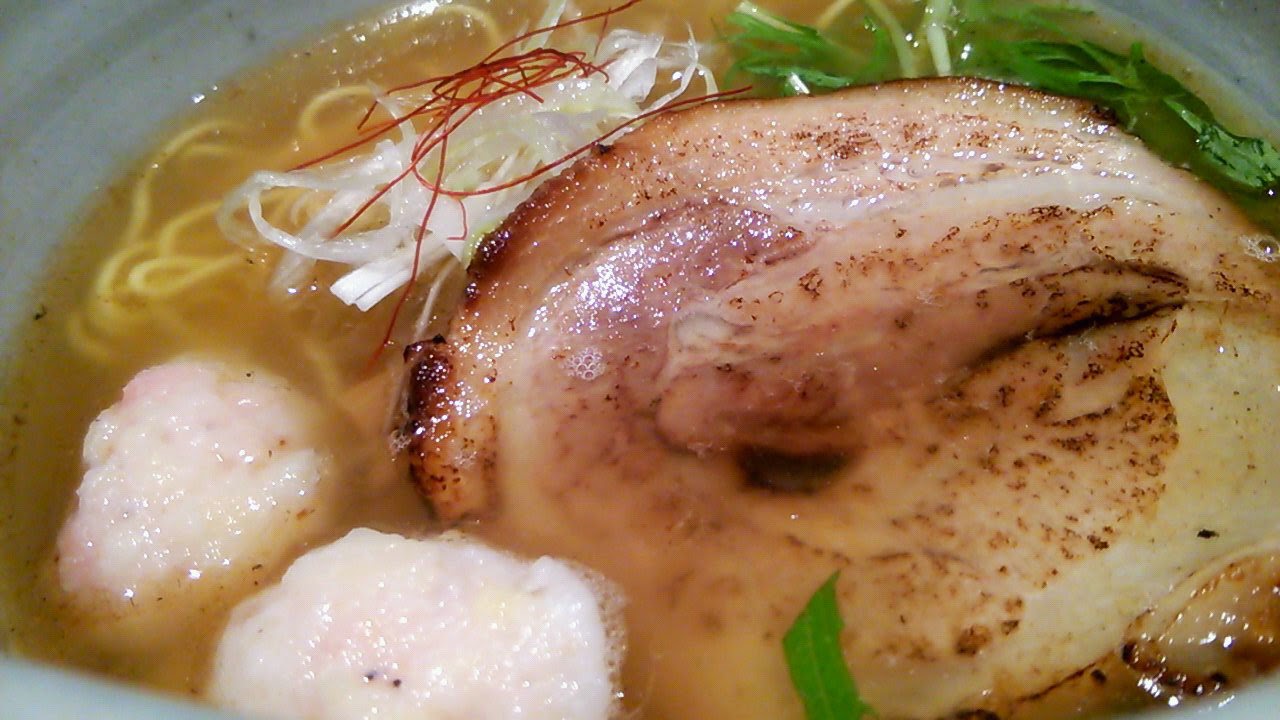
Ginzasa Shio Ramen (850yen)

When the bowl arrived, wafts of sea bream softly filled my nose. The clear soup is beautiful, and is something that would be served in a nice washoku restaurant; in other words, this is a bowl that fits its location. Even the noodles are silky and their thinness matches the soup.


The tsumire, or "fish ball," is soft and a little crunchy, with a beautiful pink color. It reminds me of Kaijinn in Shinjuku, which also serves a fish-based shio ramen.


Unfortunately, the sea bream's smell is stronger than its taste. I really wanted this bowl to have more impact and bring out the flavors of the fish. Maybe the sea bream on rice would do that if you have the appetite for it.


Ginza is a world-class area of Tokyo, but I'm not sure it's the best place to eat ramen. I couldn't feel relaxed the entire time I was here. For those who want a sleek scene, Ginsasa might be your place.

Tokyo, Chuo-ku, Ginza 8-15-2
Closest stn: Ginza

Open from 1130am-3pm and 530-10pm (closed Sundays)

Lum

Friday, December 12, 2014

つけ麺 道 Michi: kochira kameari ramen

I was way out in Kameari, home to the longest running manga ever, Kochira Katsushika-ku Kameari Koen Mae Hashutsujo, or Kochikame, for short (the title translates, literally, to "The Local Police Station in Front of Kameari Park in the Katsushika Ward). Kameari is also home to one of the highest ranked tsukemen shops in the country, which only opens for lunch. It's probably getting too cold for tsukemen, but Michi calls for an exception.


The lines here are long, and I was seriously tempted by the bento shop next door selling bentos for a ridiculous 220 yen. I think with today's exchange rates that's less than $2!


Unlike most places that overload their tsukemen with ingredients, Michi has the option of a so-tsukemen: a simple bowl with just noodles, soup, scallions, and a little "seasoning."

So-tsukemen (550yen)

The seasoning changes all the time, and this week featured a tangy yuzu kosho - spice flavored with yuzu citrus. Put a little on each bit of noodle, dip into the broth, and slurp.


The toppings looked good, too, but getting the basic version lets you savor the excellent noodles...


...and near-perfect broth, which is very similar to Menya Kisso in its smoothness. Michi's broth is frothy, and I think has a little more character and meaty gumption.


Not eating a giant bowl will also leave you room for dessert. Most ramen shops don't bother with sweets, but Michi serves a restaurant-quality creme brulee! This was the perfect after-ramen treat.


Ryo-san says you need to go to Michi, stat!


Tokyo, Katsushika-ku, Kameari 5-28-17
Closest stn: Kameari

Open from 1130am to whenever soup runs out

Hearts

Friday, December 5, 2014

満来 Manrai: city lights

On my birthday, Hearts treated me to a fancy French dinner...just kidding! We went to eat ramen, of course. He understands my needs.


I had been longing to go to Manrai for a while. It's located in busy Shinjuku, but the shop stands quietly, like a beacon of light in the crowd of passersby. While there are lines, the shop is so efficient that they move very quickly.


Though the tsukemen looked amazing, it was cold, so we both ordered the ramen.

Ramen (900yen)

The standard bowl comes brimming with toppings: a lot of spinach, bamboo shots, and a giant slab of chashu (which was a little tough and chewy). It's pricey, but I can say the cost is appropriate to the value.


The soup is tender and mild, and the noodles are a great match. Elastic and silky, they have a bright, whiter color than normal ramen noodles. The flavor is subdued, so the draw for this bowl is the easy slurpability of lots and lots of noodles, like a cross between ramen and soba.


That being said, this is a lot of food, and I probably couldn't have finished the bowl without Hearts' help. Ladies, you might want to adjust the noodle portion when taking an order. Just tell the master: Men, sukuname de onegaishimasu.


Manrai isn't extraordinary, but somehow, it's hard to stop slurping. This is nostalgic ramen for all kinds of people, and it showed in the shop's demographics: women, businessmen, families, and couples were all part of the clientele when we ate. This means that they've likely been serving the same taste, quality, and service for generations.

Tokyo, Shinjuku-ku, Nishi-Shinjuku 1-4-10
Closest stn: Shinjuku

Open from 11am-10pm

Lum